Range Repair · Denver
Wolf Burner Clicks and Will Not Catch: A Denver Diagnosis
A burner that ticks for ten seconds before it lights is a spark problem, not a gas problem. What the clicking is, why cold Denver mornings make it worse, and the five-minute checks worth doing before you call anyone.
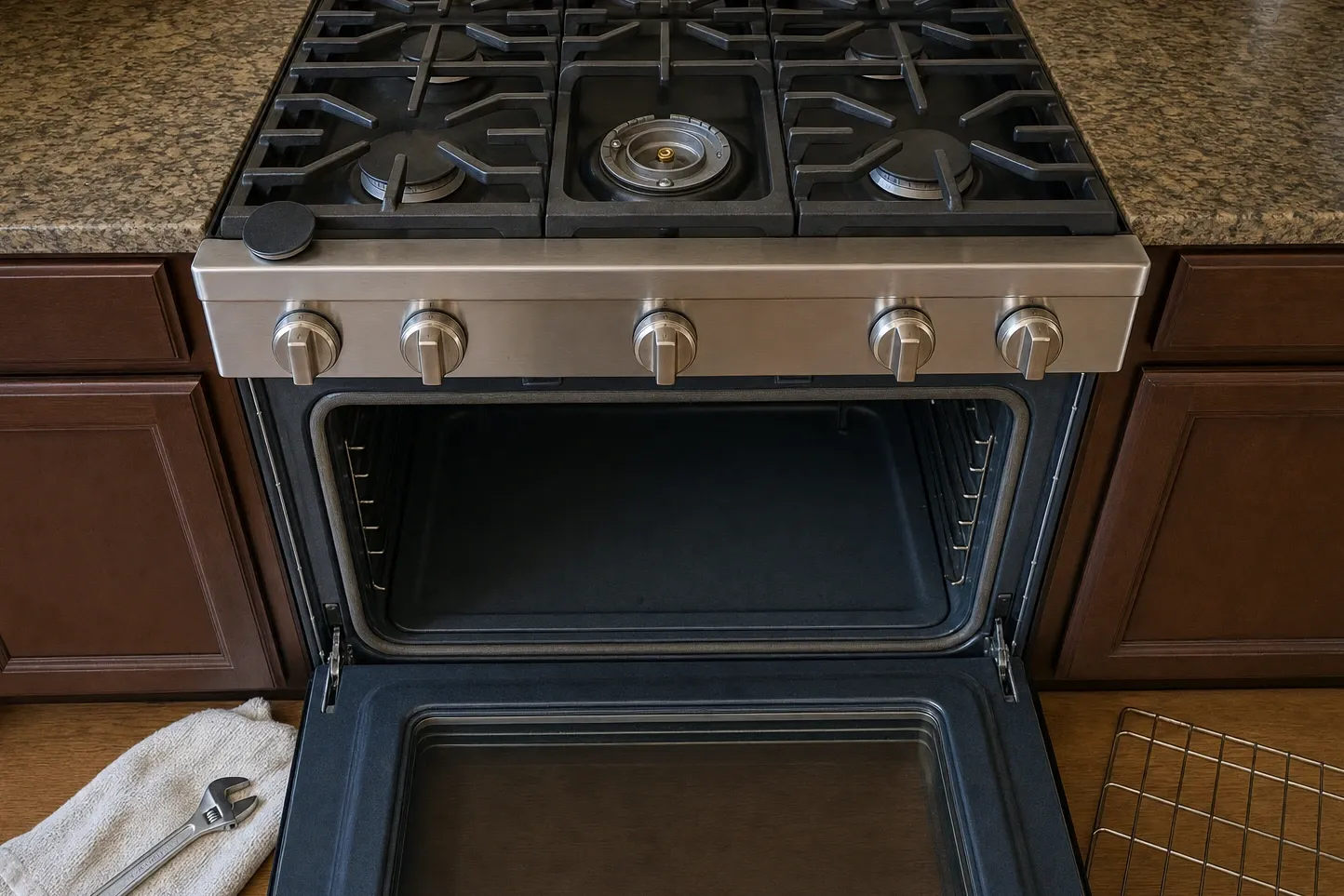
A Wolf burner that ticks four, six, ten times before it catches has almost never lost its gas. Gas is arriving — you can usually smell it for the half second before it lights. What has gone is the spark, or the module’s confidence that the spark did anything, and those are two different repairs with two different parts.
What the clicking actually is
Every sealed burner on a Wolf rangetop or range has a small ceramic-insulated electrode sitting a couple of millimetres from the burner ports. Turn the knob, the valve opens, and a spark module fires that electrode at a few times a second until it senses a flame. The clicking you hear is the spark jumping. It stopping is the module deciding the burner is lit.
Two things go wrong with that arrangement, and telling them apart is most of the diagnosis:
- The spark is weak or in the wrong place. A cracked ceramic insulator bleeds the charge into the burner base instead of jumping the gap. Boil-over baked onto the tip does the same thing. So does a cap that has been put back half-seated after a clean, which moves the ports away from the electrode.
- The spark is fine but nothing is sensing it. The same electrode reports the flame back to the module. Carbon on the tip insulates it, the module keeps firing, and you get a burner that lights properly and then clicks away underneath the flame.
The first fails to light. The second lights and will not shut up. People describe both as “the igniter is going”, which is why what you say on the phone matters more than what you conclude.
Why cold Denver mornings make it worse
Three local things stack up on a marginal electrode:
Moisture, then dryness. A kitchen that has been cooking all evening puts water into everything under the cooktop. Overnight, in a house running dry heat, that condenses on the coldest metal in the assembly. A perfect electrode does not care. One with a hairline crack in the ceramic has a conductive path across it until the burner has run long enough to dry out — which is exactly the “it is fine by lunchtime” pattern people report.
Air metered for somewhere else. At 5,280 feet the same volume of air carries roughly 17 percent less oxygen than it does at sea level. A burner still running sea-level orifices is delivering more gas than that air can burn cleanly. It lights lazily, burns tall and yellow, and lays soot on the pan bottoms and on the electrode tip. That soot is the insulator that then causes the clicking. The altitude does not break the igniter; it dirties it faster.
Dust. Dry winter air and forced-air heat pack fine dust into the vent slots behind the control panel. That is a slower problem — it cooks control boards rather than electrodes — but it is worth clearing while a panel is off anyway.
What you can check in five minutes
Worth doing yourself, in this order:
- Look at the flame on a burner that does work. Blue, tight, quiet is correct. Tall, yellow-tipped and lazy across every burner is an altitude metering job, and it is the reason the electrodes keep sooting up.
- Lift the cap off the burner that clicks. It should sit flat with no rock in it. Check the ring of ports for boil-over. A wooden toothpick clears them; a needle or a paperclip reshapes them and makes the problem permanent.
- Look at the electrode itself. You want clean white ceramic and a metal tip with a small even gap to the burner. Brown staining wipes off with a dry cloth. A chip, a crack or a black line down the insulator means the part is done — do not try to clean that one back to life.
- Dry it out. After a clean, leave the cap off for an hour before deciding anything. Half the “intermittent igniters” in this city are damp ones.
What is not worth doing: pulling the range out to get behind it, or taking the spark module out to look at it. Neither tells you anything you cannot learn from the front, and both put you next to a live gas connection.
When it is the module and not the electrode
The module is the suspect when the symptom is collective rather than individual. Every burner clicking slowly, or clicking on the wrong burner when you turn a different knob, or no click at all anywhere with the range otherwise alive — those are module and wiring faults. So is a range that clicks continuously the moment it gets power, before any knob is touched.
One electrode misbehaving while the other five are perfect is not a module fault, and replacing the module will not fix it. That distinction is worth a couple of minutes on the phone, because the module and the electrode are different parts on the van.
When to stop and call
Call, and stop using that burner, if any of this is true:
- You can smell gas when nothing is lit, or the smell lingers after a burner has been off for a minute
- The burner releases gas and takes several clicks to catch, every time
- The flame lifts off the ports, roars, or drops out on its own once it is up
- The clicking carries on with the flame clearly established
- There is a fault code on the panel alongside the ignition problem
Electrodes, spark modules and burner caps ride on the van, so an ignition fault is usually one visit. What $89 buys is the drive out plus a diagnosis taken all the way — meter on the electrode, manifold pressure read, flame watched at high and low — and that flat fee comes off the bill once you approve the work. If what you actually need is altitude orifices and the air shutters set, you will be told that instead of being sold an igniter.
Follow-ups
Is it safe to keep using a burner that clicks before it lights?
For a few days, if it lights within a second or two and the flame is steady afterwards. What is not safe is a burner that clicks, releases gas and takes several attempts to catch — that is unburned gas collecting under the cap each time. Turn that one off and use another until someone has been out.
Why does only one burner do it when they share a spark module?
Each burner has its own electrode and its own wire back to the module. A single misbehaving burner points at that electrode, its lead or its cap alignment. All of them misbehaving at once points at the module or its power supply.
The clicking never stops, even after the flame is up. Is that the same fault?
No, that is the other half of the circuit. The electrode both sparks and senses the flame; when the sensing side stops reporting, the module keeps trying. It is usually a dirty or cracked electrode, sometimes a failing module, and it is a same-visit part.